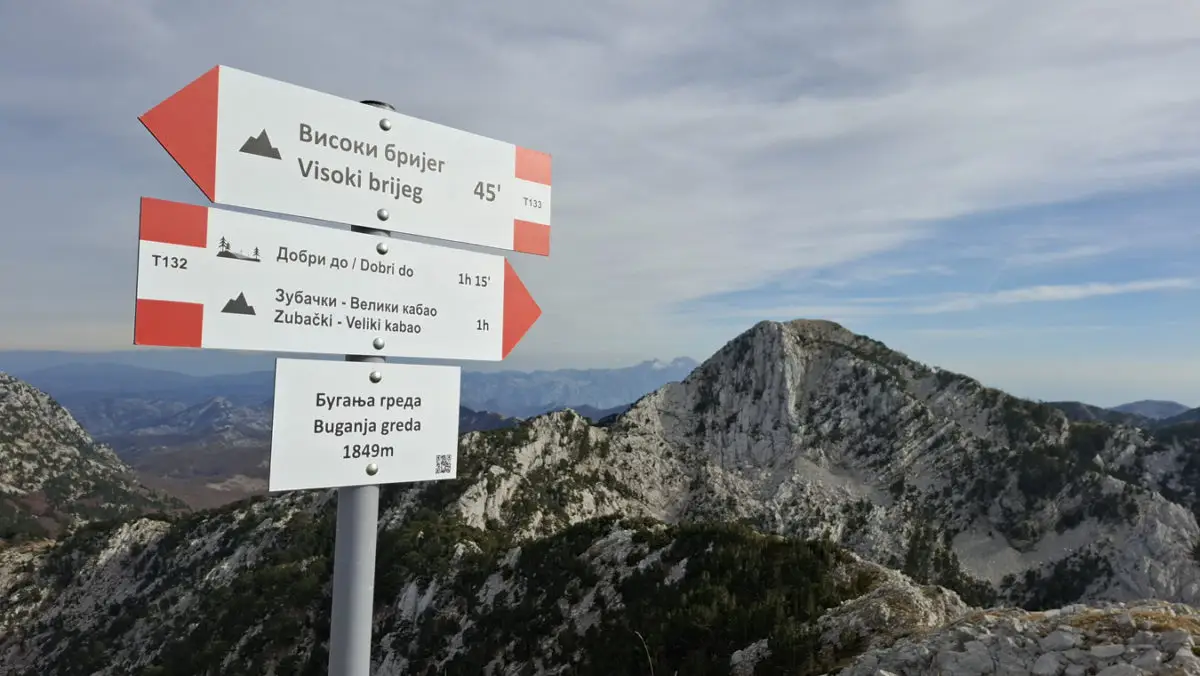
If you spend time travelling or hiking in the Balkans, you’ll eventually run into a quiet but persistent problem: Cyrillic.
Road signs. Trail markers. Bus stations. Village names.
Even if you’ve picked up a few local phrases, not being able to read the script itself makes simple navigation harder than it needs to be. You end up guessing, double-checking your phone, or stopping more often than you’d like just to confirm you’re in the right place.
The good news is that you don’t need to learn a language to solve this. You just need to be able to decode the alphabet.
Why Cyrillic Matters on the Trail
Cyrillic is still widely used across the region, often alongside the Latin script. You'll see it most commonly on:
- Road signs and town names: Often the first sign is in Latin, but the second - or the one at the crucial junction - is only in Cyrillic.
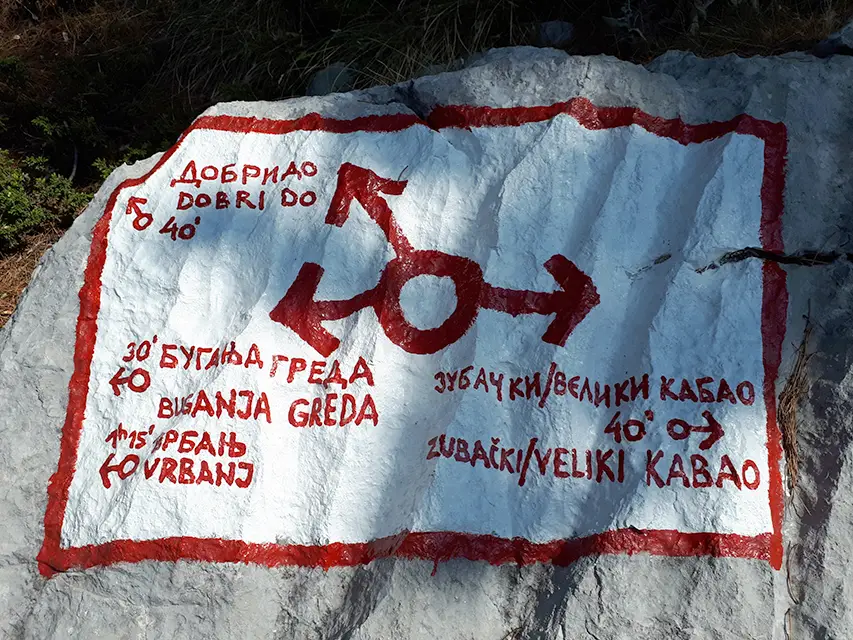
- Hiking trail markers: In places like Durmitor or the Rhodopes, wooden direction boards are frequently hand-painted in Cyrillic.
- Bus and train stations: Digital boards often cycle between scripts; if you can't read Cyrillic, you're waiting longer just to confirm a destination or platform.
- Local maps: Especially the detailed paper topographic maps you'll find in mountain huts or local shops.
In countries like Serbia, Montenegro, and Bulgaria, Cyrillic isn't just ceremonial or traditional - it's a functional reality. If you can't read it at all, you're forced to guess or constantly cross-reference your phone.
On routes like the Durmitor highlands, the Rhodopes, or quieter paths in western Serbia, trail boards are often hand-painted and never transliterated. If you can't read Cyrillic, you're relying entirely on GPS.
Cyrillic by Country: Where It Actually Matters
| Country | Importance | Why it matters |
|---|---|---|
| Bulgaria | ⭐⭐⭐⭐⭐ | Critical. Cyrillic is the only official script. |
| Serbia | ⭐⭐⭐⭐⭐ | Dominant. Most road signs and bus stations prioritize Cyrillic. |
| North Macedonia | ⭐⭐⭐⭐☆ | High. Essential once you leave the center of Skopje or Ohrid. |
| Montenegro | ⭐⭐⭐⭐☆ | Mixed. Official signs are Latin, but rural signs and markers often use Cyrillic. |
| Bosnia & Herz. | ⭐⭐⭐☆☆ | Regional. Essential for the East (e.g., Sutjeska NP); rare in the West. |
| Croatia / Albania | ⭐☆☆☆☆ | Low/None. These regions use the Latin alphabet exclusively. |
You Don't Need the Language
Cyrillic isn’t a wall of random symbols. Much of it is surprisingly logical once you know what you’re looking at.
- The identical letters: A, K, M, O, T look and sound exactly like their Latin equivalents.
- The false friends: This is where most people get tripped up. P is an R. H is an N. B is a V. A sign that looks like BODA is actually the word for water: VODA.
- The new shapes: Letters like П (P) or Г (G) look unfamiliar at first, but they’re extremely consistent.
You don’t need to learn grammar, verb conjugations, or how to order coffee politely. You just need to look at Жабљак and know it says Žabljak.
Once you can do that, maps and signs stop feeling foreign.
What Functional Reading Actually Means
For a traveller or hiker, being functional means being able to:
- Match the physical sign in front of you to the label on your GPS
- Confirm you’re on the trail to the peak, not the village with a similar name
- Read a bus or train destination without asking for help
In practice, this is about pattern recognition, not vocabulary. You’re training your brain to see a shape and associate it with a sound. Once that connection is made, the “foreignness” of the script largely disappears.
Why Guessing and Transliteration Only Go So Far
A common workaround is to visually match shapes between scripts. This is risky, because some Cyrillic letters look nearly identical to Latin ones but mean something entirely different.
Relying solely on Google Maps transliteration also has limits. Local trail markers often use different spellings or abbreviations that Google doesn’t recognise. Being able to read the letters directly is faster, calmer, and more reliable - especially when you’re tired, losing daylight, or slightly off-route.
A Practical Way to Get Functional
If you want to solve this properly, the most efficient approach is simple:
- Learn the alphabet in a clear, structured order
- Practice recognising letters inside real place names and words
- Stop once it’s “good enough”
This doesn’t need to become a long-term study plan. For most travellers, it’s a finite task that takes a few days of casual practice.
A Tool for Exactly This
If you'd rather train this properly than pick it up ad hoc, Cyrillic Daily is worth a look. It's not a language course — no grammar, no conjugations — just letter recognition using real place names, road signs, and map markers. The kind of thing you can run through in a few days before a trip.
Final Thought
Cyrillic in the Balkans isn't something you need to master. It's just a hurdle to clear.
Once you can read the signs, the landscape opens up. You move more independently, rely less on your phone battery, and feel more oriented in the places that matter.